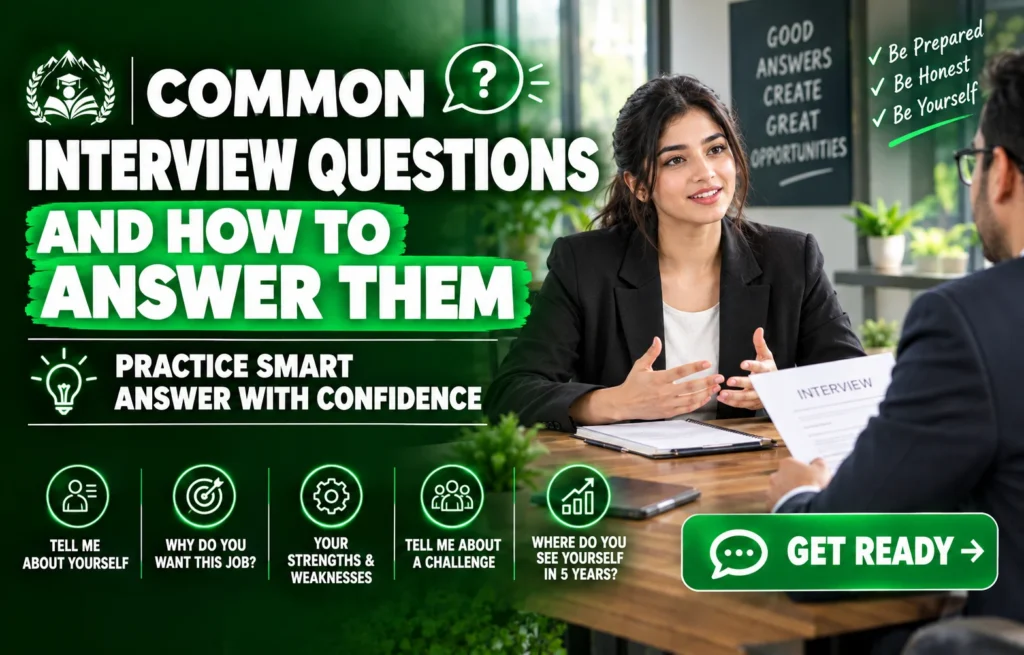
Quick Answer: Most interviews in Pakistan — government or private — repeat the same 8 to 10 core questions. If you prepare structured, specific answers for these ahead of time, you walk into almost any interview room already 70% ready. This guide breaks down each question, why it’s asked, and how to answer it for both FPSC/PPSC panels and private-sector interviews.
Search “common interview questions” and you’ll get thousands of generic listicles, most written for corporate interviews abroad, full of vague advice like “just be yourself.” That’s not particularly useful when you’re preparing for a PPSC panel that expects procedural clarity, or a private HR round in Karachi that wants specific numbers and results. This guide is built around how these questions actually get asked — and evaluated — in Pakistan.
Why the Same Questions Keep Coming Up
Interview panels, whether it’s a three-member FPSC board or a single HR manager, are working with limited time and a simple goal: figure out if you’re the right fit, fast. Certain questions consistently do that job well — they reveal your self-awareness, your communication under pressure, and whether you’ve actually prepared or just showed up.
Definition Box — Key Terms:
- Behavioral Question: A question asking you to describe a past situation (“Tell me about a time when…”), used to predict how you’ll handle similar situations in the role.
- Selection Board: In FPSC/PPSC interviews, a panel of 3–5 officers assessing subject knowledge, personality, and general aptitude alongside your written test score.
- STAR Method: Situation, Task, Action, Result — a simple way to structure any example-based answer so it stays specific instead of vague.
The Core Questions You Should Prepare For
1. “Tell Me About Yourself”
This isn’t an invitation to repeat your CV. Panels want a short, structured summary: your background, your most relevant experience or education, and why you’re sitting in that chair.
Structure: Present (what you do now) → Past (relevant experience or education) → Future (why this role, specifically).
Sample answer: “I recently completed my degree in Public Administration, and during my internship at a district office, I worked on improving record-keeping processes. I’m now looking to build a long-term career in public service, and this post lines up directly with the administrative and analytical skills I’ve developed.”
Pro Tip: Keep this under 60 seconds. Going longer signals you don’t know how to prioritize information — a bad sign for any role involving reports or communication.
2. “Why Should We Hire You?”
This tests whether you can connect your strengths directly to what the role needs, rather than just listing qualities. Pick two or three relevant strengths, tie them to the post’s actual requirements, and close with one confident line about the value you’ll add. (We’ve covered this one in full detail in a separate guide, since it deserves its own breakdown.)
3. “What Is Your Biggest Weakness?”
The trap here isn’t admitting a weakness — it’s picking a fake one (“I work too hard”) that sounds rehearsed. Panels can spot that instantly.
Better approach: Name a real, minor weakness, and immediately show what you’re doing to manage it.
Sample answer: “I used to spend too long perfecting small details on reports before submitting them. I’ve since started setting internal deadlines for each section, which has made my work both faster and just as accurate.”
4. “Where Do You See Yourself in 5 Years?”
For government interviews, this question is quietly checking your genuine intent toward public service — panels want to see long-term commitment, not someone using the post as a stepping stone. For private-sector roles, it’s checking ambition balanced with realism.
Expert Tip: Avoid overly specific answers like “Section Officer by 2031.” Focus instead on growth, skill-building, and increasing responsibility within the field.
5. “Why Do You Want to Work Here?” (or “Why This Department?”)
This is where most candidates lose points by giving a generic answer that could apply to any job. Panels want evidence that you’ve actually researched the department, ministry, or company.
Sample answer for a private-sector role: “I’ve followed [Company]’s recent expansion into digital banking, and I’m particularly interested in contributing to that shift given my background in fintech reporting.”
6. “Describe a Challenge You Faced and How You Handled It”
This is a behavioral question — use the STAR method (Situation, Task, Action, Result) to keep your answer specific instead of drifting into vague generalities.
Sample answer: “During my final semester [Situation], I was assigned to lead a group project with a tight two-week deadline [Task]. I split tasks based on each member’s strength and set daily check-ins [Action], and we submitted the project two days early with the highest grade in the class [Result].”
7. “What Do You Know About This Organization/Department?”
For FPSC/PPSC candidates, this often means knowing the department’s core function, recent policy changes, or its role within the broader government structure. For private-sector roles, it means knowing what the company actually does, not just its name.
Common Mistake: Reciting information copied directly from a website homepage. Panels notice when an answer sounds memorized rather than understood.
8. “Do You Have Any Questions for Us?”
Never say “no.” This is your chance to show genuine engagement.
Good questions to ask:
- “What does success look like in this role after the first six months?”
- “What are the department’s current priorities this year?”
Avoid asking: Anything about salary or leave policy at this stage — save that for a later round.
Government vs. Private Interviews: Key Differences
| Focus Area | Government (FPSC/PPSC) | Private Sector |
|---|---|---|
| What’s evaluated most | Procedural knowledge, long-term intent | Measurable past results |
| Ideal answer length | Short, structured, time-conscious | Slightly more conversational |
| Weakness questions | Handled cautiously, formally | Can be framed more casually |
| “Why this role” answer | Genuine public service motivation | Company/industry-specific research |
Common Mistakes Candidates Make
- Memorizing word-for-word scripts. Panels can tell, and it makes you sound robotic under follow-up questions.
- Giving the same answer to different questions. If your “biggest strength” and “why should we hire you” answers sound identical, you haven’t prepared enough variety.
- Speaking too fast under nerves. A brief pause before answering looks far more composed than rushing.
- Not tailoring answers to the specific post. Generic answers are one of the fastest ways to lose marks in a competitive selection process.
Frequently Asked Questions
How many interview questions should I prepare for?
Focus on the 8 to 10 core questions covered here. Almost every interview — government or private — draws from this same pool with minor variations.
Should I prepare different answers for government vs. private interviews?
Not entirely different, but adjust your tone and emphasis. Government answers should lean more formal and highlight long-term public service intent; private answers can highlight measurable results more directly.
How long should each answer be?
Aim for 30 to 90 seconds per question, depending on complexity. Shorter for direct questions like “tell me about yourself,” slightly longer for behavioral ones.
What if I don’t know the answer to a technical question?
It’s better to admit you’re unsure and explain how you’d find the answer than to guess incorrectly. Panels generally respect honesty over false confidence.
Is it okay to ask the interviewer to repeat a question?
Yes. Asking for clarification shows attentiveness, not weakness — it’s far better than answering the wrong question confidently.
Final Word
You can’t predict every question an interview panel will ask, but you can prepare for the handful that come up again and again. Build specific, structured answers for each of the questions above, practice them out loud, and adapt the tone depending on whether you’re facing an FPSC board or a private HR manager. Preparation like this is what separates candidates who freeze under pressure from the ones who walk out of the room confident they did their best.