
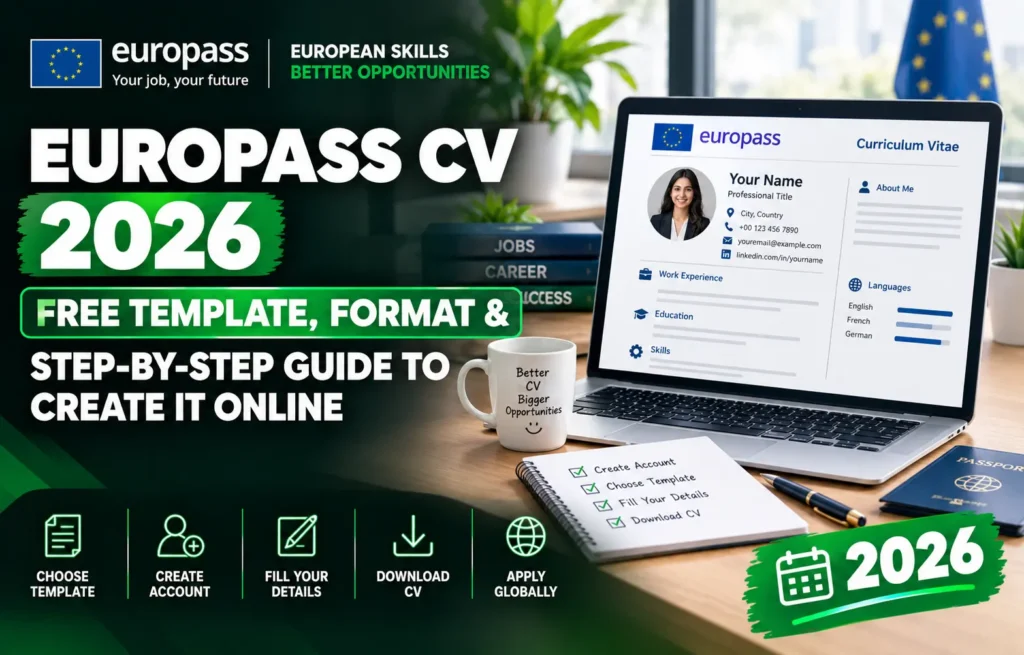
If you are planning to study, work, or apply for a scholarship in a European country, chances are you have already come across the term “Europass CV.” Many universities, employers, and scholarship programs across Europe specifically ask applicants to submit their CV in this exact format. If you’re not familiar with it, don’t worry — this guide will explain everything in simple words, from what a Europass CV actually is, to how you can create your own for free in just a few minutes.
What Is a Europass CV?
Europass CV is a standard curriculum vitae format developed by the European Union to make it easier for employers, universities, and recruiters across Europe to understand and compare applicants’ qualifications. Since different countries traditionally use different CV styles, the Europass format was introduced to create one common structure that works everywhere in the EU.
In simple words, a Europass CV is a clean, well-organized, and internationally recognized CV format that presents your education, skills, work experience, and personal details in a way that is instantly familiar to European recruiters.
Why Is Europass CV So Important?
You might be wondering why you can’t just use a normal CV instead. Here are a few reasons why the Europass format matters:
- Many European universities and scholarship programs (like Erasmus Mundus) require it specifically
- It is widely recognized and trusted by employers across all EU countries
- It presents information in a structured, easy-to-scan format
- It reduces confusion for recruiters who receive applications from many different countries
- It looks professional and consistent, regardless of who creates it
If a scholarship or job posting mentions “please attach your Europass CV,” submitting a regular CV instead could weaken your application, even if your qualifications are strong.
Who Should Use a Europass CV?
You should consider preparing a Europass CV if you are:
- Applying for a scholarship in a European country
- Applying for a job or internship within the EU
- A student applying to a European university
- Applying for programs like Erasmus+ or Erasmus Mundus
- Seeking work opportunities through EU-based job portals
Even if it’s not mandatory for a specific opportunity, having a ready Europass CV can save you time whenever such a requirement comes up.
What Information Goes Into a Europass CV?
A Europass CV generally includes the following sections, in a structured order:
1. Personal Information
- Full name
- Address
- Phone number
- Email address
- Nationality
- Date of birth (optional in most cases)
2. Personal Statement / Profile Summary
A short paragraph describing who you are, your career goals, and what you bring to the table. This section should be brief — usually 3 to 5 lines.
3. Work Experience
List your work history in reverse chronological order (most recent first), including:
- Job title
- Company name
- Duration of employment
- Key responsibilities and achievements
4. Education and Training
Include your academic background, again in reverse order:
- Degree or qualification name
- Institution name
- Duration of study
- Relevant coursework or achievements (optional)
5. Language Skills
Europass CV uses a special table format based on the Common European Framework of Reference for Languages (CEFR). You rate your listening, reading, speaking, and writing skills for each language from A1 (beginner) to C2 (proficient).
6. Digital Skills
List your proficiency in tools like Microsoft Office, Google Workspace, coding languages, or any relevant software.
7. Other Skills
This can include soft skills, communication skills, teamwork, leadership, or any certifications you hold.
8. Driving License (if applicable)
Some versions of the Europass CV include a section for your driving license category, which may be relevant for certain job applications in Europe.
How to Create a Europass CV Online (Step-by-Step Guide)
Creating a Europass CV is much simpler than most people expect. Here’s how you can do it:
Step 1: Visit the Official Europass Website
Go to the official Europass portal, which is the only trusted source for creating this CV format. Avoid random third-party websites claiming to offer “Europass templates,” as they may not follow the official structure.
https://pakistanhaal.com/cv-builder/
Step 2: Create a Europass Profile
You will need to create a free account or profile on the platform. This allows you to save your information and update it later whenever needed.
Step 3: Fill in Your Personal Details
Enter your basic information, including your name, contact details, and nationality, exactly as they appear on your official documents.
Step 4: Add Your Education and Work Experience
Enter your academic background and any work experience in the required fields. Be accurate and consistent with dates.
Step 5: Add Language and Digital Skills
Rate your language proficiency using the CEFR scale, and list your digital or technical skills.
Step 6: Review Your CV
Once all sections are filled, review the entire CV carefully. Check for spelling mistakes, incorrect dates, or missing information.
Step 7: Download Your CV
After reviewing, you can download your Europass CV as a PDF file, ready to be attached to your applications.
Common Mistakes to Avoid While Creating a Europass CV
Many applicants lose good opportunities simply because of small, avoidable mistakes. Keep these points in mind:
- Don’t leave sections empty – If a section doesn’t apply to you, it’s better to write “Not Applicable” rather than leaving it blank.
- Avoid exaggerating skills – Especially with language ratings, since interviews may test your actual proficiency.
- Keep it updated – Update your CV regularly, especially after gaining new experience or certifications.
- Use professional language – Avoid casual or overly informal wording.
- Double-check personal details – Make sure your name, email, and contact number are correct, since a small typo can cost you an opportunity.
- Match the CV to the opportunity – Slightly tailor your personal statement depending on whether you’re applying for a scholarship, internship, or job.
Europass CV vs Normal CV – What’s the Difference?
Many people confuse a Europass CV with a regular CV, but there are a few key differences:
| Feature | Europass CV | Normal CV |
|---|---|---|
| Format | Fixed, standardized structure | Flexible, varies by person |
| Recognition | Recognized across EU countries | Recognition varies by country |
| Language Skills | Rated using CEFR scale | Usually described in simple terms |
| Design | Simple, uniform layout | Can be customized freely |
| Best Used For | EU scholarships, jobs, universities | General job applications worldwide |
If you’re applying outside Europe, a normal, well-designed CV may work better. But for European opportunities specifically, the Europass format is often expected or preferred.
Tips to Make Your Europass CV Stand Out
Even though the format is fixed, you can still make your CV impressive by following these tips:
- Write a strong, concise personal statement that highlights your goals clearly
- Focus on achievements rather than just listing duties in your work experience
- Be honest but confident about your language and digital skills
- Keep your CV to 2 pages maximum, unless the opportunity specifically requires more detail
- Proofread multiple times, or ask someone else to review it before submission
Final Thoughts
A Europass CV is more than just a formality — it is often the first impression you make on a European university, employer, or scholarship committee. Taking the time to fill it out carefully, honestly, and professionally can genuinely improve your chances of selection.
If you’re planning to apply for scholarships, jobs, or study programs in Europe, preparing your Europass CV in advance will save you time and stress later. Once created, you can easily update and reuse it for multiple applications in the future.
FAQ’s
What is a Europass CV used for?
It is used for job applications, scholarships, and university admissions across European Union countries, presenting your information in a standardized format.
Is Europass CV free to create?
Yes, the Europass CV can be created completely free of cost through the official Europass website.
Is Europass CV mandatory for all European applications?
Not always, but many universities, scholarships, and employers specifically request it, so it’s a good idea to have one ready.
Can I use Europass CV for jobs outside Europe?
It’s not commonly required outside Europe, but there’s no harm in using it if you find its clean structure helpful.
How long should a Europass CV be?
Ideally, it should be kept to a maximum of 2 pages for clarity and easy reading.