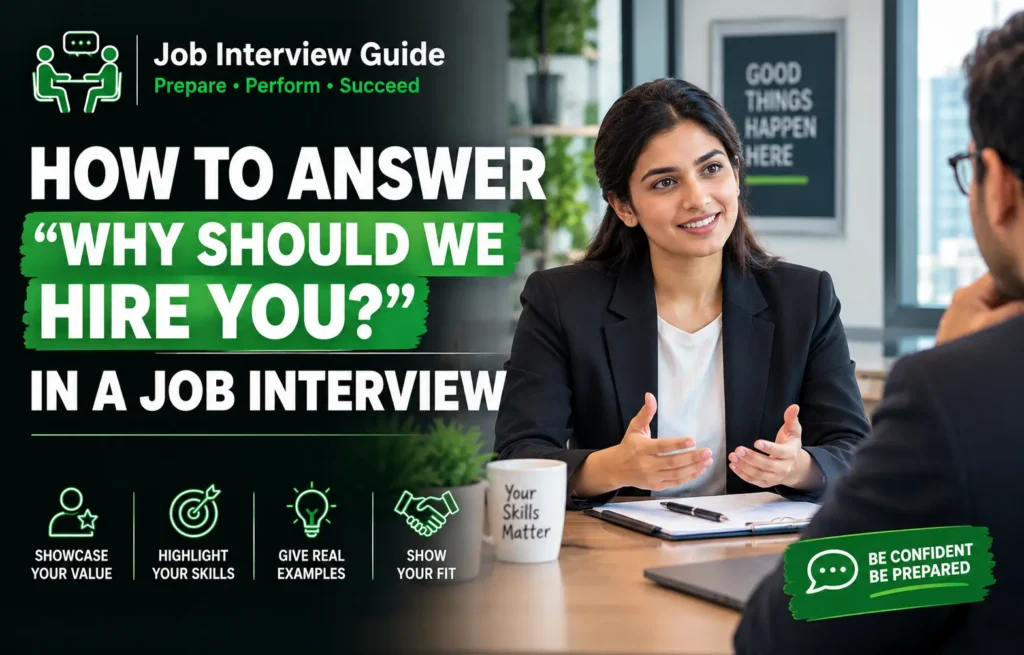
Quick Answer: Pick two or three strengths that actually match what this job needs, explain how they solve a real problem the employer has, and finish with one confident line about the value you’ll bring — all in under a minute. That’s it. No script, no memorized paragraph, just a structure you can fill in for any interview.
If you’ve searched this question online, you’ve probably found answers built for a different job market — American resume coaches talking about “personal branding” and “elevator pitches.” That’s fine if you’re interviewing at a Silicon Valley startup. It’s a lot less useful when you’re actually walking into a PPSC interview room or sitting across from an HR manager in Lahore who’s already read your CV twice and just wants to know one thing: can you explain, in plain words, why you’re the right person for this specific seat?
This article breaks that down for both government and private-sector interviews in Pakistan — what the question is really testing, a simple framework you can adapt to any role, sample answers for different career stages, and the mistakes that quietly cost candidates the job.
Why Do Interviewers Even Ask This?
It feels like an unfair question. You’ve already submitted your CV, cleared the written test, maybe even scored well. So why make you say it out loud?
Because a panel isn’t just checking your qualifications at this point — they’re checking three other things:
- Self-awareness. Do you actually know what you’re good at, or are you guessing?
- Communication under pressure. Can you explain your value clearly in the moment, without rambling?
- Fit for this exact post. Not jobs in general — this one, in this department, with these responsibilities.
In FPSC and PPSC interviews especially, the panel usually isn’t learning anything new about your marks or degree here. They’re watching how you present yourself when put on the spot. That’s the real test.
The 3-Part Framework
You don’t need a perfect script. You need a structure flexible enough to reuse for any interview, government or private:
1. Name your strengths — but only the relevant ones.
Not “I’m hardworking and a team player.” Pick two or three things that actually connect to this job’s requirements.
2. Connect them to what the role needs.
This is the step most candidates skip. Read the job ad. What are they actually asking for? Say how your strength solves that specific need.
3. Close with a confident, short statement.
One sentence. No apologizing, no over-promising. Just a clear line about the value you bring.
A simple way to build it:
“I bring [strength one] and [strength two], which line up directly with [what this post needs]. In my [past role/degree], I [one specific example], and I’m confident I can deliver the same here.”
Keep it under a minute. Government panels especially move fast between candidates — a tight, well-organized 40-second answer will always beat a nervous two-minute one. Say it out loud a few times before your interview so it sounds natural, not rehearsed.
Sample Answers by Career Stage
Fresh Graduate — Government Post (BPS-14 to 16)
“During my final year, I worked on a research project that involved organizing and analyzing district-level data for a government internship. I learned to work carefully under deadlines and communicate findings clearly to supervisors. I understand this post requires strong record-keeping and attention to detail, and I believe my academic background has prepared me well for that responsibility.”
Why this works: One real example, tied directly to what the post likely needs, without exaggeration.
Experienced Candidate — FPSC/PPSC
“I’ve spent the last five years working in administrative operations, where I was responsible for maintaining compliance records and meeting strict reporting timelines. Alongside that, I’ve prepared thoroughly for this post’s syllabus and performed well in the relevant sections of the written exam. I believe combining that practical experience with subject knowledge makes me well-suited for this role.”
Why this works: It reminds the panel of test performance without sounding boastful, and grounds the claim in actual experience.
Career Changer — Moving Into Public Service
“I’ve worked in the private banking sector for the past six years, handling audits and financial reporting. While this would be my first role in government service, the core skills — accuracy, following strict compliance procedures, and meeting hard deadlines — apply directly here. I’ve also studied this post’s requirements closely and I’m committed to building a long-term career in public service.”
Why this works: It doesn’t hide the career switch — it reframes it as an advantage.
Private-Sector Candidates — What to Emphasize
| Candidate Type | Focus in Your Answer | Emphasize |
|---|---|---|
| Fresh graduate | Internship or academic project | One measurable result |
| Experienced professional | Past achievement | Numbers — % growth, cost savings, time saved |
| Career changer | Transferable skills | Direct link between old and new role |
| Technical roles (IT, engineering) | A specific project | Tools used, problem solved, outcome |
| Remote-to-office transition | Independent work habits | Deadline discipline, communication tools used |
Tip: Before any private-sector interview — a bank in Islamabad, a tech firm in Karachi, wherever — read the job posting twice and underline the three requirements that repeat most. Build your answer around those three, not your entire resume.
Mistakes That Cost Candidates the Job
- Being vague. “I’m dedicated and hardworking” tells the panel nothing they can actually evaluate.
- Reciting your CV. They’ve already read it. This question asks you to connect it to their need — not repeat it.
- Underselling yourself. Modesty is not the goal here. If you don’t state your value clearly, no one else will.
- Overpromising. Avoid lines like “I’m the best candidate here” unless you can immediately back it up.
- Using the same generic answer everywhere. A one-size-fits-all response signals you haven’t actually looked into this specific post or company.
Quick Tips Before Your Interview
- Write down your top two or three strengths for this specific job beforehand, along with one real example for each.
- If you blank out mid-answer, it’s fine to pause and say, “Let me gather my thoughts for a second.” Panels respect composure far more than a rushed, messy answer.
- For government interviews, always pair your skills with genuine motivation for public service — panels consistently weigh long-term intent as a real factor.
FAQs
How do I answer this with no work experience?
Lean on internships, academic projects, or leadership roles in university societies. Give one specific, measurable example, and pair it with genuine enthusiasm to learn.
What’s the ideal length for this answer?
30 to 60 seconds. Long enough to make your point, short enough to keep attention.
Should I mention weaknesses in this answer?
No — save that for a direct “what’s your biggest weakness” question. This one is only about your strengths and value.
Is it okay to memorize a script?
Better to memorize the structure (strength → connection → confident close) and keep the wording natural. Interviewers can usually tell when something is rehearsed word-for-word.
How does this differ between government and private interviews?
Government panels tend to weigh long-term commitment and procedural understanding more heavily. Private-sector interviewers usually focus more on measurable results and how well you’d fit the company culture.
Final Word
There’s no perfect universal answer to “Why should we hire you?” — but there is a reliable structure: know your strengths, understand exactly what this specific role needs, and connect the two in a short, confident statement. Whether you’re walking into an FPSC panel or a private HR interview in Karachi, practicing this framework with your own real examples will get you further than any memorized script ever could.